

This Article Was Last Updated: August 29, 2026 by Victor Odia
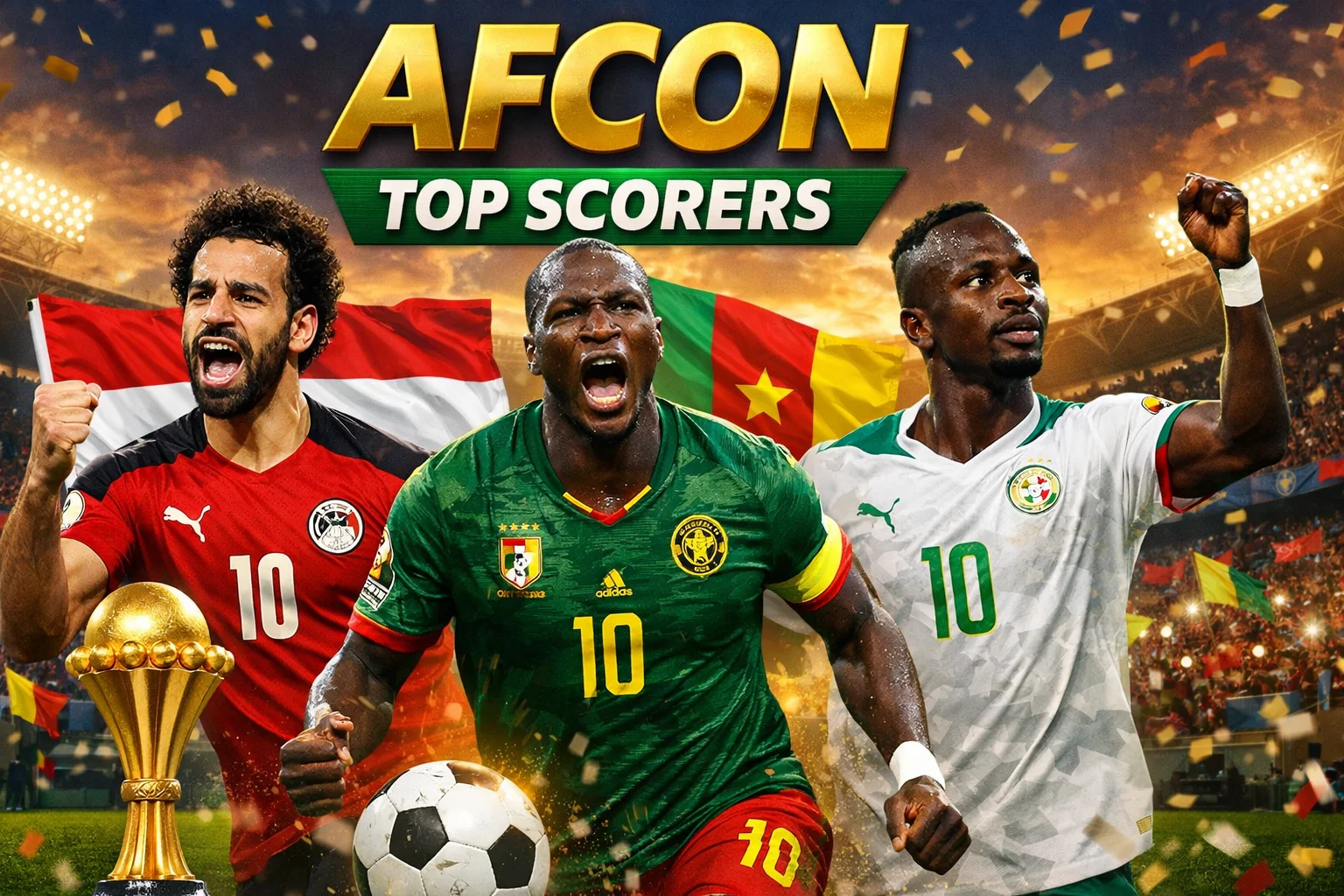
The Africa Cup of Nations has seen some of Africa’s fiercest strikers ever, and the AFCON top scorers list shows who really owned the pitch. From all-time leading goal scorers to golden boot winners, these players smashed records and kept fans on their toes.
Looking at the highest goal scorers in AFCON history, AFCON scoring records, and the top AFCON strikers of all time, it’s clear who made their mark. Whether you’re checking the most goals scored in AFCON or the AFCON top goal scorers by year, these legends know how to find the back of the net.
AFCON Top Scorers Ranked by All-Time Goals
Ndaye Mulamba — 10 goals
Ndaye Mulamba was a goal machine for DR Congo. He scored 10 goals in just 10 AFCON matches. That’s a goal per game. He still holds the record for most goals in a single AFCON tournament. He hit nine in 1974. No one has beaten that.
There isn’t much public detail about his club career. But his 1974 performance is the stuff of legend. Whenever people talk about the greatest AFCON runs ever, his name always comes up.
Patrick Mboma — 11 goals
Patrick Mboma was born on 15 November 1970. He is one of Cameroon’s top strikers. He scored 11 goals in 17 AFCON matches. Mboma helped Cameroon win the tournament in 2000 and again in 2002. He showed up when it mattered most.
At club level, he played in France, Japan and Italy. He was known for smart runs and sharp finishing. Give him a chance, and he would take it. He shared the AFCON Golden Boot in one edition and was named African Footballer of the Year in 2000.
Defenders hated facing him. Fans in Cameroon still bring up his name when they talk about the country’s football greats.
Hossam Hassan — 11 goals
Egypt’s powerhouse striker, Hossam Hassan, scored 11 AFCON goals across seven tournaments. He’s Egypt’s all-time top scorer with 69 goals in 177 appearances.
At club level he starred for Al Ahly, where he won loads of league titles and cups, and also played for Zamalek and others. Famous for his deadly finishing and clutch goals, he even shared the AFCON top scorer award in 1998.
Didier Drogba — 11 goals
Didier Drogba was born in Ivory Coast and went on to become one of Africa’s most iconic strikers. He scored 11 goals in 24 AFCON matches.
Dropping into European club football, he played for clubs like Le Mans, Marseille and most famously Chelsea, where he won Premier League titles and the Champions League and became known as a clutch forward who delivered in big games.
For Ivory Coast, he became captain and led them to multiple World Cups and AFCON finals.
Mohamed Salah — 11 goals
Mohamed Salah is an Egyptian forward who is famous around the world and still playing today. He has scored 11 goals at the Africa Cup of Nations and became the first Egyptian to score in five AFCON tournaments in a row.
He was born in Egypt and became a star at Liverpool, winning the Premier League and the Champions League while breaking goal records. Salah is very fast, smart with his movement and calm in front of goal.
Salah has passed many African greats in international goals and is still scoring. Young players across Africa see him as a role model.
Sadio Mané — 11 goals
Sadio Mané is a Senegalese forward who has also scored 11 goals at AFCON across six tournaments. He’s Senegal’s all time top scorer with over 50 goals for his country and helped Senegal win their first AFCON title in 2021 and again later on.
At club level he starred for clubs like Liverpool, winning the Premier League, the Champions League and many individual awards.
Hassan El Shazly — 12 goals
Hassan El Shazly was an Egyptian striker long before most people today were born. He played in the 1960s and early 1970s and became famous for scoring goals every time he stepped on the AFCON pitch, ending with twelve goals in eight games, which is an insane ratio.
Shazly was born in Egypt and played mainly for Al Masry in the domestic league back then, though older records don’t always have full details about club goals, so those are harder to pin down. He was known for scoring lots of hat tricks in AFCON finals and had a knack for finding space and finishing when it mattered most.
Egypt didn’t win the title during his peak years, but fans still talk about his sharpness in front of goal decades later.
Rashidi Yekini — 13 goals
Rashidi Yekini was born on 23 October 1963. He played for Nigeria during the golden years of the Super Eagles. He scored 13 AFCON goals between 1988 and 1994. That made him one of the most feared strikers in the tournament.
At club level, he moved around a lot. He played in Nigeria, Portugal, Spain, Switzerland and Saudi Arabia. He was known for his strength and powerful shot. Beyond AFCON, he was Nigeria’s all-time top scorer for many years with about 37 goals. He helped Nigeria win AFCON in 1994 and also played at the World Cup.
Laurent Pokou — 14 goals
Laurent Pokou was born on 10 August 1947 in Abidjan, Ivory Coast, and passed away on 13 November 2016. He stood about 1.78 m tall and played as a striker.
He scored 14 goals at AFCON across a handful of tournaments between the late 1960s and 1980, with a jaw-dropping five goals in one game against Ethiopia once. Pokou played his club football mostly for ASEC Abidjan and later had a good spell with Rennes in France, where he scored plenty of goals in Ligue 1.
His style was all about instinct and finishing, and he was once the top scorer in AFCON history before others overtook him. He inspired a generation of Ivorian strikers and later even had a stadium named after him in his home country.
Samuel Eto’o — 18 goals
Samuel Eto’o was born on 10 March 1981 in Douala, Cameroon. He became the all time AFCON goals king with 18 goals in 29 matches across six tournaments.
He also had a legendary club career with teams like Barcelona and Inter Milan, winning Champions Leagues and league titles, and he was named African Footballer of the Year several times. Eto’o represented Cameroon in multiple World Cups and won Olympic Gold in 2000.
Quick, sharp and deadly in front of goal, he has inspired generations of African players and is often spoken of as one of the best Africa has ever produced.



Football is my talent