

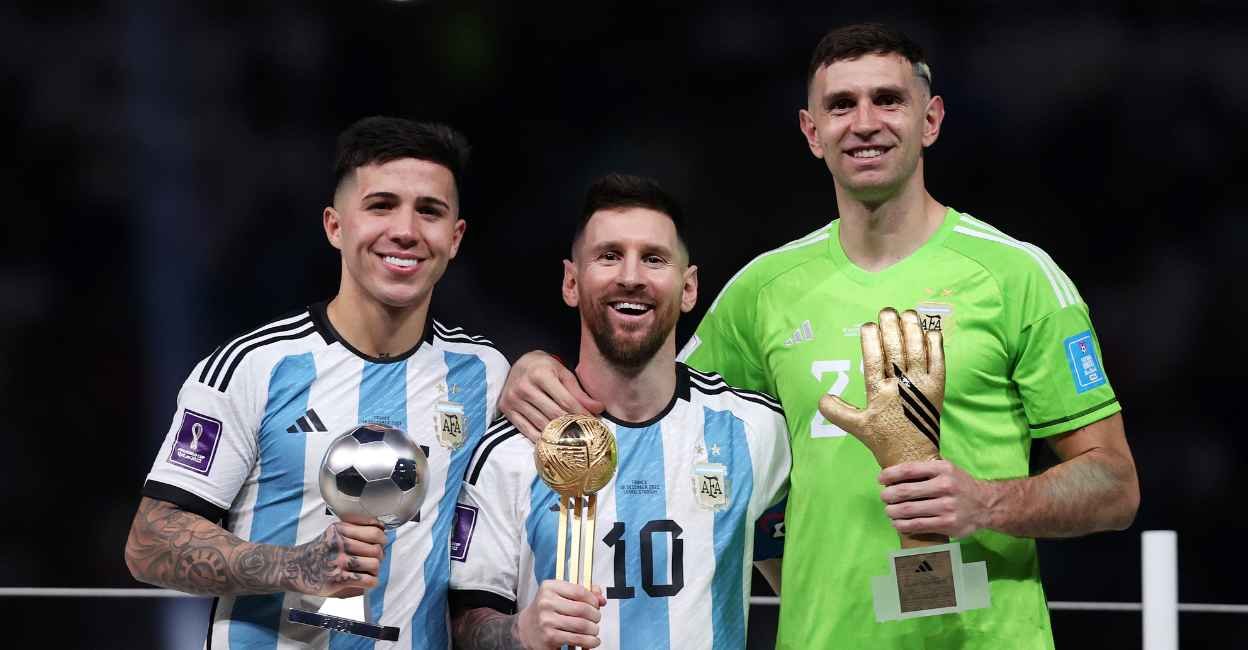
This Article Was Last Updated: August 29, 2026 by Victor Odia
Beyond the ultimate prize of lifting the FIFA World Cup trophy, the tournament honours outstanding individual players and teams with a series of official awards.
FIFA presents these awards at the end of every World Cup to celebrate exceptional performances. They add another layer of competition by recognising the players and teams that leave the biggest mark on each tournament.
Each award serves a distinct purpose, follows clearly defined selection criteria, and carries a rich history within the FIFA World Cup.
This guide explains what each award represents, how FIFA selects the winners, and why these honours continue to hold a special place in FIFA World Cup history.
Besides competing for football’s biggest prize, teams also earn substantial financial rewards. You can also read our complete guide to FIFA World Cup prize money to see how much every nation receives.
What Are FIFA World Cup Awards?
Although the World Cup is a team competition, FIFA also celebrates individual performances that shape matches and influence results. These awards highlight skill, consistency, leadership, goal scoring, goalkeeping, and sportsmanship.
FIFA presents four main awards. The Golden Ball honours the tournament’s best player. Golden Boot rewards the top goalscorer, using assists and minutes played to break ties when needed. The Golden Glove recognises the best goalkeeper for outstanding performances throughout the tournament. Meanwhile, the FIFA Fair Play Award honours the team that shows the highest standards of discipline, respect, and sportsmanship in the knockout stage.
These awards recognise excellence beyond winning the FIFA World Cup trophy. As a result, players and teams can earn individual honours even if they do not win the tournament. This approach allows FIFA to celebrate outstanding performances in every position.
Official FIFA World Cup awards differ from media and fan awards. FIFA chooses its winners through the Technical Study Group, tournament statistics, and fair play criteria. In contrast, media organisations and fans create their own Best XI teams, player rankings, and other honours. While these awards attract attention, FIFA does not recognise them as official World Cup awards.
Golden Ball Award (FIFA World Cup Best Player)
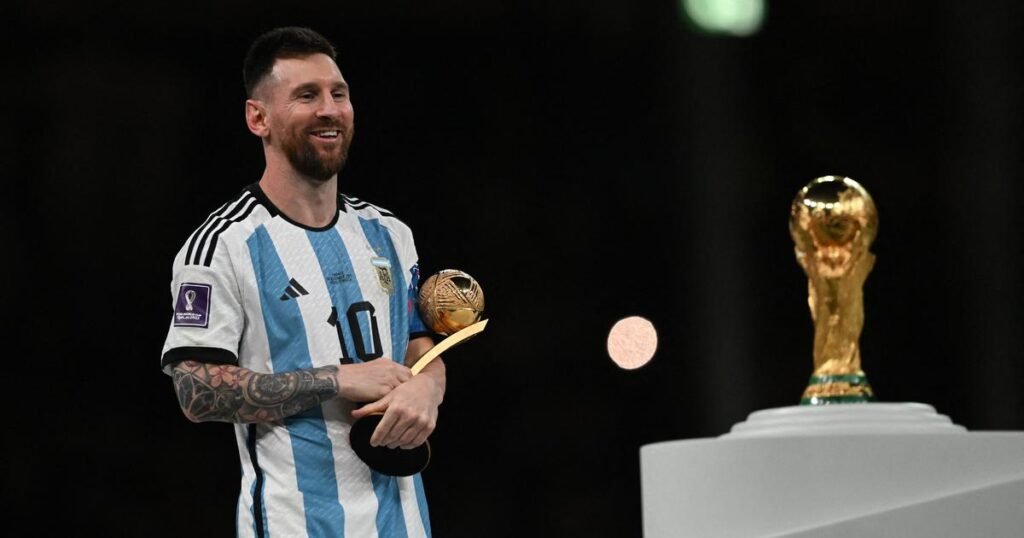
What the Golden Ball Means
FIFA awards the Golden Ball to the best player at the FIFA World Cup. The award recognises the player who makes the biggest overall impact during the tournament, not simply the highest goalscorer.
The Golden Ball rewards technical ability, creativity, leadership, consistency and influence in key matches. As a result, it ranks among football’s highest individual honours and matches popular searches for “FIFA World Cup best player.”
FIFA introduced the award in 1982. Adidas sponsors it, while the runners-up receive the Silver Ball and Bronze Ball.
How the Winner Is Selected
Accredited media representatives vote for the Golden Ball winner after FIFA’s Technical Study Group (TSG) creates a shortlist of the tournament’s top performers.
Voters assess players based on:
- Technical skill
- Influence on matches
- Leadership
- Consistency throughout the tournament
- Performances in the knockout rounds
The award rewards overall performance instead of goals alone. Therefore, a player can win the Golden Ball without winning the Golden Boot.
Past Winners and Legends
The Golden Ball has honoured many of football’s greatest players.
| World Cup | Winner | Achievement |
| 1982 | Paolo Rossi | Led Italy to the World Cup title. |
| 1986 | Diego Maradona | Produced one of the greatest World Cup campaigns in history. |
| 1990 | Salvatore Schillaci | Became Italy’s breakout star. |
| 1994 | Romário | Led Brazil to the World Cup title. |
| 1998 | Ronaldo | Drove Brazil’s run to the final. |
| 2002 | Oliver Kahn | Became the only goalkeeper to win the Golden Ball. |
| 2006 | Zinedine Zidane | Guided France to the World Cup final. |
| 2010 | Diego Forlán | Carried Uruguay to the semi-finals. |
| 2014 | Lionel Messi | Led Argentina to the World Cup final. |
| 2018 | Luka Modrić | Guided Croatia to its first World Cup final. |
| 2022 | Lionel Messi | Captained Argentina to the title and became the first player to win two Golden Ball awards. |
Winning the Golden Ball places a player among the greatest performers in World Cup history. It also highlights consistent excellence on football’s biggest stage.
As of June 2026, the FIFA World Cup is still in progress. FIFA has not announced the 2026 Golden Ball winner.
Why It Matters
The Golden Ball stands among football’s most prestigious individual awards because it rewards complete performances instead of goals alone.
Winning the award can:
- Strengthen a player’s legacy
- Increase global recognition
- Raise commercial value
- Support future individual honours
- Confirm elite status in World Cup history
Every player dreams of lifting the FIFA World Cup trophy. Meanwhile, the Golden Ball recognises the tournament’s best overall player with its highest individual honour.
Golden Boot Award (Top Scorer)
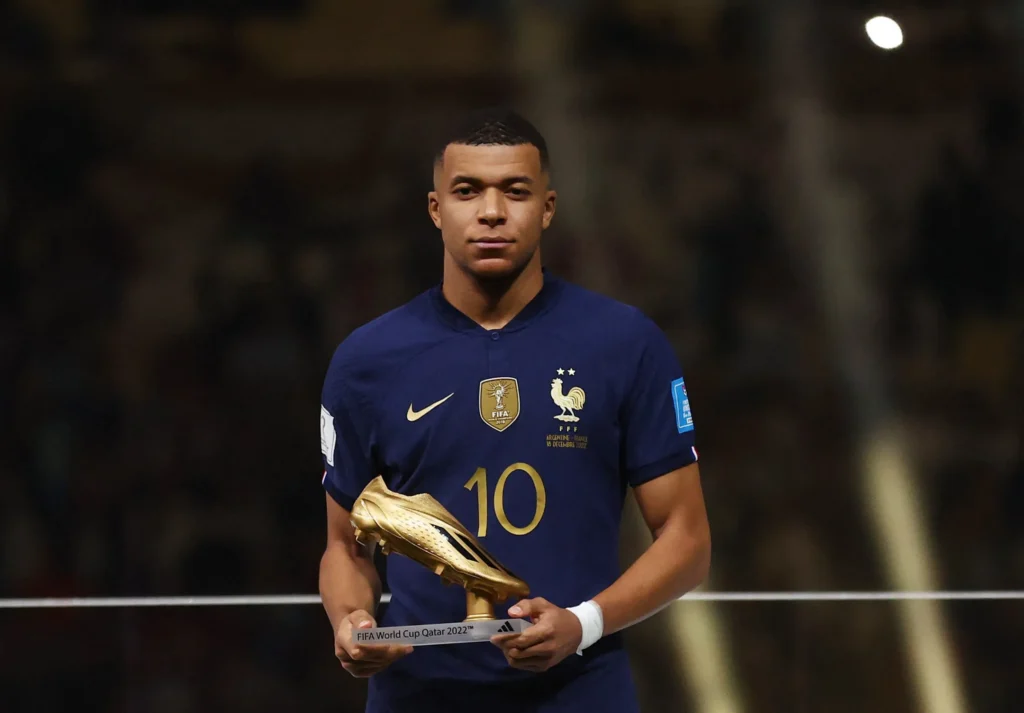
What the Golden Boot Represents
The Golden Boot recognises the top goalscorer at the FIFA World Cup. FIFA awards it to the player who scores the most goals during the tournament, from the group stage to the final.
FIFA introduced the award as the Golden Shoe in 1982 and renamed it the Golden Boot in 2010. It also awards the Silver Boot and Bronze Boot to the players who finish second and third in the scoring charts.
The expanded 48-team FIFA World Cup in 2026 allows finalists to play up to eight matches instead of seven. As a result, forwards have more opportunities to score, making the Golden Boot race even more competitive.
Tie-Break Rules
If two or more players finish with the same number of goals, FIFA applies these tie-break rules.
Assists
FIFA gives the Golden Boot to the player with the most assists.
Example:
- Player A: 6 goals, 4 assists
- Player B: 6 goals, 2 assists
Player A wins the award.
Minutes Played
If players remain level on goals and assists, FIFA compares the number of minutes they played.
The player who scores the same number of goals in fewer minutes ranks higher.
Shared Awards
FIFA no longer shares the Golden Boot simply because players finish level on goals.
Instead, FIFA first compares assists and then minutes played. Therefore, players rarely finish level after applying both tie-breakers.
Famous Golden Boot Winners
Many of football’s greatest goalscorers have won the Golden Boot.
| World Cup | Winner | Country | Goals |
| 1958 | Just Fontaine | France | 13 |
| 1978 | Mario Kempes | Argentina | 6 |
| 1986 | Gary Lineker | England | 6 |
| 1994 | Oleg Salenko* | Russia | 6 |
| 1998 | Davor Šuker | Croatia | 6 |
| 2002 | Ronaldo | Brazil | 8 |
| 2006 | Miroslav Klose | Germany | 5 |
| 2010 | Thomas Müller | Germany | 5 |
| 2014 | James Rodríguez | Colombia | 6 |
| 2018 | Harry Kane | England | 6 |
| 2022 | Kylian Mbappé | France | 8 |
Oleg Salenko shared the award in 1994 before FIFA introduced the current tie-break system.
Just Fontaine still holds the World Cup record with 13 goals in the 1958 tournament. No player has broken that record.
Many Golden Boot winners also feature among the Premier League’s all-time top scorers after enjoying prolific club careers. If you’re interested in international scoring records, see our AFCON top scorers throughout tournament history.
Tactical Importance
The Golden Boot rewards more than clinical finishing. It also reflects how teams create scoring chances. Similar scoring races also exist in domestic competitions, including the NPFL top scorers every season.
Central Strikers Remain The Favourites
Central strikers usually win the Golden Boot because they receive the highest number of chances inside the penalty area. Coaches build many attacks around their main goalscorer, who finishes crosses, through balls and cut-backs.
Players such as Kylian Mbappé, Harry Kane, Ronaldo and Miroslav Klose all benefited from this role.
Attacking Midfielders Can Also Win
Attacking midfielders can challenge for the Golden Boot when they regularly join attacks and arrive late in the penalty area.
James Rodríguez proved this in 2014 by scoring six goals for Colombia while operating behind the striker.
Team Success Creates More Chances
Teams that reach the semi-finals or final play more matches. Consequently, their attacking players receive more opportunities to score.
The expanded 2026 tournament increases that advantage by adding an extra match for finalists.
Set-Piece Duties Help
Penalty takers and free-kick specialists often score additional goals during the tournament. Consequently, they improve their chances of winning the Golden Boot.
Team Tactics Influence The Race
Modern teams create more scoring opportunities through high pressing, quick transitions and attacking full-backs. These tactics supply central strikers and attacking midfielders with more chances in front of goal.
As a result, the Golden Boot rewards players who combine excellent finishing with strong support from their team’s attacking system.
Golden Glove Award (Best Goalkeeper)
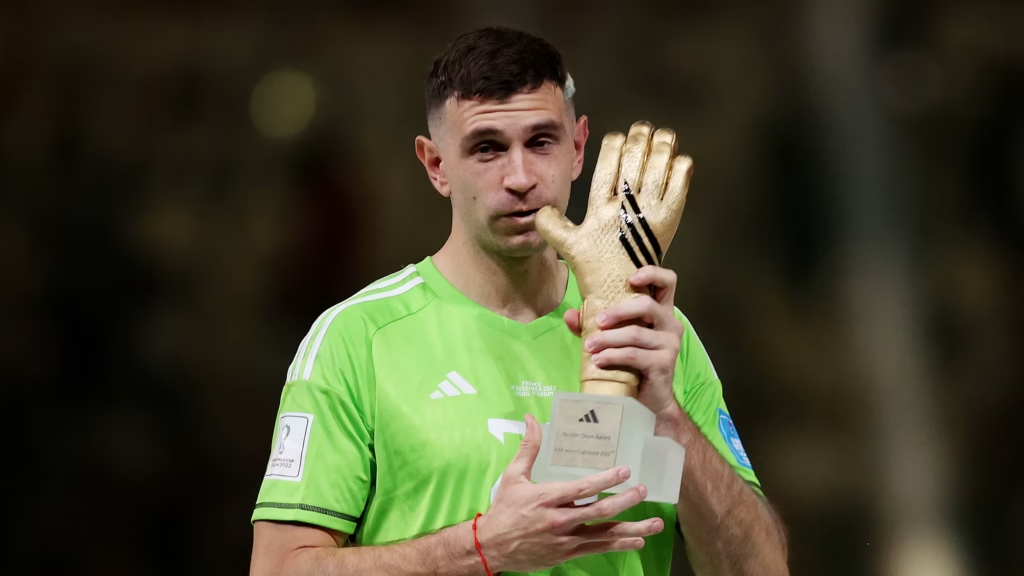
What the Award Recognises
FIFA presents the Golden Glove to the best goalkeeper at the FIFA World Cup. The award honours the goalkeeper who delivers the strongest overall performances throughout the tournament, not simply the one with the most clean sheets.
FIFA’s Technical Study Group chooses the winner by assessing performances across every stage of the competition. The panel considers consistency, crucial saves, leadership and overall influence on matches.
Most winners play for teams that reach the semi-finals or final. This record highlights the important role goalkeepers play in World Cup success.
Selection Criteria
FIFA does not follow a fixed scoring system. Instead, the Technical Study Group evaluates several key areas before selecting the winner.
Clean Sheets
Clean sheets remain one of the strongest measures of goalkeeping performance. They show that a goalkeeper helps prevent goals and works effectively with the defence.
However, FIFA does not rely on clean sheets alone. The panel also considers the quality of the opposition and the goalkeeper’s overall contribution in each match.
Saves
Goalkeepers strengthen their chances by making difficult and timely saves. Stopping clear scoring opportunities often separates the best performers from the rest.
In addition, penalty saves and decisive stops in knockout matches carry greater weight because they can change the outcome of a game.
Leadership and Impact
Modern goalkeepers do much more than stop shots. They organise the defence, communicate with teammates and remain calm under pressure.
They also start attacks with accurate passing and confident decision-making. As a result, FIFA rewards goalkeepers who influence every phase of play.
Evolution of the Award
Formerly “Yashin Award”
FIFA introduced the award in 1994 as the Yashin Award to honour legendary Soviet goalkeeper Lev Yashin, the only goalkeeper to win the Ballon d’Or.
In 2010, FIFA renamed the honour the Golden Glove. Although the name changed, the award continued to recognise the tournament’s best goalkeeper.
Modern Criteria Changes
Football has expanded the goalkeeper’s role over the years. Earlier evaluations focused mainly on shot-stopping ability.
Today, FIFA also assesses ball distribution, positioning, decision-making and sweeper-keeper skills. Consequently, goalkeepers must contribute in both defence and attack to stand out.
Legendary Goalkeepers
Several goalkeepers have shaped World Cup history with outstanding performances.
- Michel Preud’homme became the first winner in 1994.
- Fabien Barthez helped France win the 1998 World Cup.
- Oliver Kahn claimed both the Golden Glove and the Golden Ball in 2002, making history as the only goalkeeper to win both awards at the same tournament.
- Gianluigi Buffon guided Italy to the 2006 World Cup title.
- Iker Casillas led Spain to their first World Cup triumph in 2010.
- Manuel Neuer transformed the position with his sweeper-keeper style in 2014.
- Thibaut Courtois inspired Belgium to a third-place finish in 2018.
- Emiliano Martínez helped Argentina win the 2022 World Cup with several match-winning saves.
Many Golden Glove winners have also lifted the World Cup trophy. Today, the Golden Glove rewards complete goalkeepers. The best winners make vital saves, lead their defence, control the penalty area and help launch attacks from the back.
Several Golden Glove winners spent their careers at some of the world’s richest football clubs, where they competed at the highest level every season.
FIFA Fair Play Award
The FIFA Fair Play Award celebrates discipline, respect, and sportsmanship in football. While most awards recognise performance, this honour rewards players, teams, coaches, officials, and fans who protect the spirit of the game. Since 1987, FIFA has recognised actions that promote fairness and respect on and off the pitch.
At the FIFA World Cup, FIFA gives the Fair Play Trophy to the knockout-stage team with the best disciplinary record. As a result, every yellow and red card can affect the final rankings.
Meaning of Fair Play in Football
Fair play goes beyond following the rules. It encourages players and teams to compete honestly, respect everyone involved, and accept decisions without misconduct.
Discipline, Respect, And Sportsmanship
Fair play means that players and teams:
- Follow the Laws of the Game.
- Respect referees and opponents.
- Control their emotions during matches.
- Accept decisions without arguing or abusing officials.
- Promote equality and reject discrimination.
Together, these values protect football’s reputation and encourage healthy competition.
How the Winner Is Decided
FIFA ranks eligible teams by their disciplinary records throughout the World Cup. Only teams that reach the knockout stage can win the Fair Play Trophy.
Yellow/Red Cards
FIFA calculates each team’s disciplinary record by reviewing:
- Yellow cards.
- Second yellow cards that lead to a red card.
- Direct red cards.
- Yellow cards followed by a direct red card.
Therefore, teams that receive fewer cards have a better chance of winning the trophy.
Team Behaviour
FIFA also looks for professional behaviour throughout the tournament. Players and coaching staff strengthen their team’s reputation when they stay disciplined and respect the spirit of the game.
Respect For Opponents And Officials
Teams should respect opponents and match officials throughout every match. They improve their disciplinary record when they avoid dissent, unsporting behaviour, and unnecessary confrontations.
Why It Still Matters
The FIFA Fair Play Award reminds everyone that football involves more than winning. It celebrates integrity, respect, and responsible behaviour at every level of the sport.
Promotes Integrity In Global Football
Finally, the award encourages teams to compete fairly and discourages misconduct and discrimination. As football continues to grow around the world, fair play protects the sport’s credibility and sets a strong example for future generations.
Other FIFA World Cup Recognitions
Besides the Golden Ball, Golden Boot, Golden Glove and Fair Play Trophy, FIFA also honours outstanding players and teams with several additional awards. While FIFA still presents some of these honours today, it has retired or renamed others.
Man of the Match Awards
FIFA introduced the Man of the Match award in 2002 to recognise the best player in every World Cup match.
For the 2026 FIFA World Cup, FIFA renamed the award the Michelob Ultra Superior Player of the Match under a new sponsorship agreement.
Fans vote on FIFA’s digital platforms during each game, and FIFA announces the winner shortly after the final whistle.
The 2026 tournament has already created several talking points. For example, Jude Bellingham declined the award after England’s draw with Ghana because he believed a Ghanaian player deserved it. Likewise, some fans criticised other selections, showing that the award often sparks debate.
Unlike tournament honours, FIFA presents this award after every World Cup match.
Young Player Award
FIFA created the Young Player Award in 2006 to recognise the tournament’s best young footballer. Players must be under 21 at the start of the calendar year in which the World Cup takes place. If you enjoy learning about emerging football stars, you may also like our feature on the youngest players in AFCON history.
Later, FIFA selected winners for earlier tournaments dating back to 1958.
The 2026 tournament has not produced a winner yet because the competition is still underway. However, several young stars have already emerged as leading contenders. You can also explore the youngest goalscorers in AFCON history to see how Africa’s brightest talents made their mark.
Team of the Tournament
The Team of the Tournament recognises the best XI players of the World Cup.
FIFA changed the selection process over time.
- From 1994 to 2006, FIFA’s Technical Study Group selected the official All-Star Team.
- Since 2010, FIFA has stopped selecting an official Team of the Tournament.
- Instead, football media outlets, analysts and statistics providers now publish their own Best XI selections based on tournament performances.
As a result, fans will likely see several unofficial Teams of the Tournament after the 2026 World Cup instead of one official FIFA selection.
Historical Or Discontinued Awards
FIFA has retired, renamed or reduced the use of several World Cup awards over the years.
| Award | Current Status | Description |
| All-Star Team | Discontinued | FIFA selected the official team until 2006. Since then, media organisations have produced unofficial Best XI teams. |
| Most Entertaining Team | Rarely used | Fans voted for the team that played the most attractive football during the tournament. |
| Goal of the Tournament | Active | Fans choose the tournament’s best goal after the World Cup ends. |
| Man of the Match | Renamed | FIFA has changed the sponsor several times and now presents the award as the Michelob Ultra Superior Player of the Match for the 2026 tournament. |


. Discover how winners are chosen & what they mean)