This Article Was Last Updated: August 29, 2026 by Victor Odia
This guide breaks down the confirmed 2026 FIFA World Cup prize money, including the total prize pool, how much the winners and runners-up earn, the payment structure for every stage of the tournament, what each national football federation receives, and how players usually share performance bonuses within their squads.
FIFA approved a record financial distribution for the expanded 48-team competition, making the 2026 World Cup the most lucrative tournament in the competition’s history.
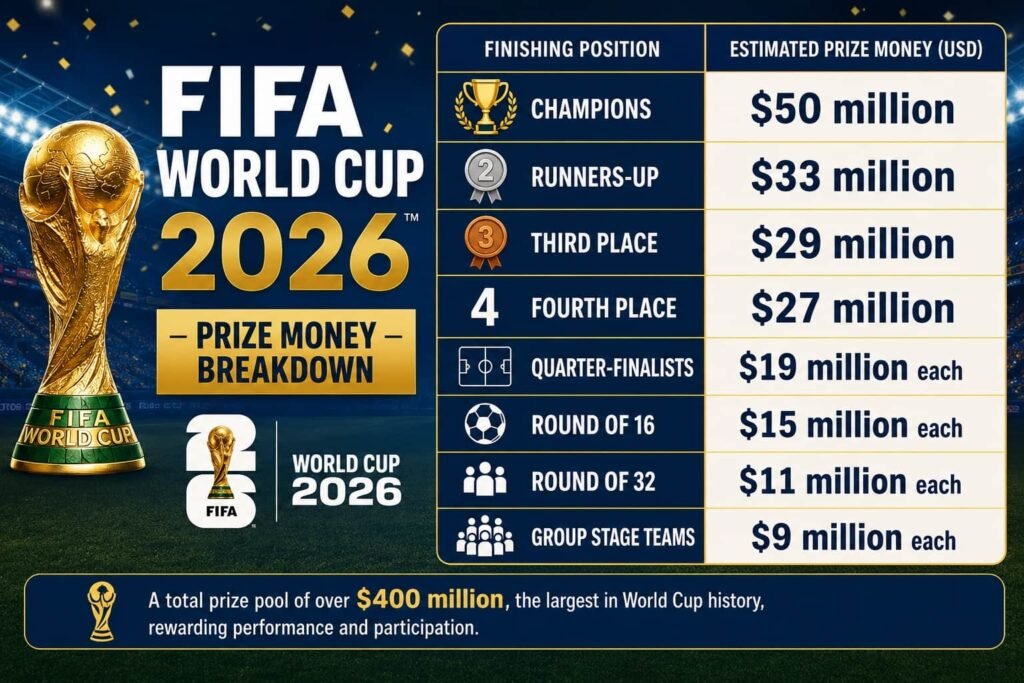
FIFA World Cup 2026 Prize Money Breakdown
| Finishing Position | Estimated Prize Money (USD) |
| Champions | $50 million |
| Runners-up | $33 million |
| Third Place | $29 million |
| Fourth Place | $27 million |
| Quarter-finalists | $19 million each |
| Round of 16 | $15 million each |
| Round of 32 | $11 million each |
| Group Stage Teams | $9 million each |
Every qualified team also receives a tournament preparation grant, raising the minimum payment to about US$10.5–12.5 million.
Prize money has also increased significantly over the years. The total prize fund grew from US$440 million in 2022 to US$871 million in 2026, making it the largest in FIFA World Cup history.
Total FIFA World Cup Prize Pool Through History
| Tournament | Teams | Prize Pool (USD) |
| 2006 | 32 | $266 million |
| 2010 | 32 | $420 million |
| 2014 | 32 | $576 million |
| 2018 | 32 | $400 million |
| 2022 | 32 | $440 million |
| 2026 | 48 | $655 million (prize money) / $871 million (total distribution) |
FIFA has increased World Cup prize money as revenue has grown. For 2026, FIFA will award $655 million in performance-based prize money. In addition, qualification and preparation grants will raise the total distribution to $871 million.
Growth of FIFA Revenue
FIFA’s revenue has grown from about $3.2 billion in the 2006 cycle to nearly $13 billion for the 2023–2026 cycle. As revenue increased, FIFA also raised prize money and expanded football development.
Commercial Sponsorships
Global partners, including Adidas, Coca-Cola, Visa, Hyundai Motor Group, Lenovo, Qatar Airways and Aramco, generate a large share of FIFA’s revenue. The 2026 tournament also creates more sponsorship opportunities with 48 teams, 104 matches and three host countries.
Broadcasting Rights
Broadcasting rights remain FIFA’s biggest revenue source. The expanded tournament offers more live matches, streaming content and advertising opportunities. As a result, FIFA expects media rights to generate nearly $4 billion during the 2023–2026 cycle.
Tournament Expansion
The 2026 FIFA World Cup expands from 32 to 48 teams and from 64 to 104 matches. Consequently, the larger tournament will increase ticket sales, sponsorship revenue and broadcasting income, supporting the biggest World Cup prize fund in history.
How Much Do FIFA World Cup Winners Earn? (2026)
The 2026 FIFA World Cup winners will earn a record US$50 million, the biggest champion’s prize in tournament history. FIFA increased the payout after expanding the competition to 48 teams.
Champion’s Prize
FIFA awards US$50 million to the winning national football association. The prize is US$8 million higher than the US$42 million awarded to the 2022 champions. The federation then shares the money with players, coaches and staff under pre-tournament agreements.
Medal Bonuses
FIFA does not pay players a fixed cash bonus for winning the World Cup. Instead, each federation sets its own bonus system. Some split the prize money equally, while others reward players with appearance and performance bonuses.
Trophy vs Financial Reward
The champions receive more than prize money. They lift the original FIFA World Cup Trophy during the presentation ceremony, collect gold medals and keep a gold-plated replica. However, FIFA keeps the original trophy.
Historical Comparison
The winner’s prize has increased steadily:
- 2006: US$20 million
- 2010: US$30 million
- 2014: US$35 million
- 2018: US$38 million
- 2022: US$42 million
- 2026: US$50 million
Biggest Increase
The 2026 champions earn 19% more than the 2022 winners and 150% more than the 2006 champions. As a result, the 2026 FIFA World Cup offers the highest winner’s prize in the tournament’s history.
How Much Do the Runners-up Earn?
The 2026 FIFA World Cup runners-up will earn US$33 million in prize money after losing the final.
Meanwhile, the third-place team will receive US$29 million, while the fourth-place team will earn US$27 million.
Prize money rises with each higher finish. The runners-up earn US$4 million more than the third-place team and US$6 million more than the fourth-place team. However, the biggest increase is between first and second place. The champions receive US$50 million, which is US$17 million more than the runners-up.
Therefore, reaching the final guarantees one of the tournament’s biggest payouts, while each higher finish brings a larger financial reward.
How Much Does Every Qualified Team Receive at the 2026 FIFA World Cup?
Every qualified team receives guaranteed payments before the tournament begins. Teams then earn more money as they progress through the competition.
Guaranteed Participation Payment
Each qualified team receives:
- Qualification payment: USD 10 million
- Tournament preparation grant: USD 2.5 million
Together, these payments guarantee every nation at least USD 12.5 million.
Group Stage Earnings
Teams that exit in the group stage receive a USD 9 million performance prize. This brings their total earnings to about USD 21.5 million.
Knockout Round Bonuses
FIFA increases prize money at every knockout stage. However, it pays teams according to their final finishing position instead of adding rewards from each round.
Additional Performance-Based Rewards
FIFA also pays clubs through its USD 355 million Club Benefits Programme for releasing players. National football associations can reward players with bonuses from their prize money. Successful teams may also earn extra income from sponsorship and commercial deals, as seen in profiles such as Bukayo Saka’s net worth and salary.
Estimated Earnings By Stage Reached
| Stage Reached | Estimated Total Earnings (USD) |
| Group stage | 21.5m |
| Round of 32 | 23.5m |
| Round of 16 | 27.5m |
| Quarter-finals | 31.5m |
| Fourth place | 39.5m |
| Third place | 41.5m |
| Runner-up | 45.5m |
| Champion | 62.5m |
How Much Money Do Football Federations Receive?
National football federations receive money from FIFA through World Cup payments and development programmes. For the 2026 FIFA World Cup, every qualified federation receives a guaranteed US$12.5 million. This includes a US$10 million qualification payment and a US$2.5 million preparation grant. In addition, performance bonuses range from US$9 million for the group stage to US$50 million for the champions. Therefore, the winning federation can earn about US$62.5 million.
Federations receive the money directly and decide how to spend it. Most use it for player bonuses, coaching staff, travel, tournament costs, and daily operations. They also invest part of the funds in long-term football development.
Moreover, FIFA supports grassroots football through the FIFA Forward programme. Federations use this funding to expand community leagues, school football, coach education, and referee training.
Infrastructure is another priority. Many associations build training centres, improve stadiums, upgrade football headquarters, and install new pitches. These projects improve football facilities and create better playing conditions.
At the same time, federations invest in youth academies, talent scouting, youth leagues, and age-group national teams. These programmes help develop future players.
Women’s football also receives funding. Associations support domestic leagues, girls’ competitions, coaching, refereeing, and national teams to grow the women’s game.
Finally, federations strengthen their national teams by funding training camps, friendly matches, sports science, medical support, and coaching. As a result, FIFA funding helps national associations improve football at every level, from grassroots programmes to elite international competition.
Do FIFA World Cup Players Receive Bonuses?
Yes. FIFA World Cup players can receive bonuses, but FIFA does not pay them directly. Instead, FIFA gives prize money to each national football federation, which decides how much players, coaches and staff receive. For the 2026 FIFA World Cup, FIFA approved a record financial package of nearly US$900 million, with the champions earning US$50 million.
Each federation sets its own bonus system before the tournament. As a result, payments vary by country. Common rewards include appearance bonuses for making the squad, win bonuses for victories, and extra payments for reaching the knockout stage, final or winning the World Cup. Some federations share bonuses equally, while others base payments on appearances or playing time.
In addition, some governments offer rewards for outstanding performances. After Argentina won the 2022 FIFA World Cup, players received national honours alongside federation bonuses. Likewise, Morocco’s squad received financial rewards and official recognition after reaching the semi-finals. Saudi Arabia also reportedly promised players luxury cars after their famous group-stage win over Argentina.
Players may also earn sponsor bonuses. Companies such as Nike, Adidas and Puma often include performance incentives in endorsement contracts. These rewards may depend on winning the World Cup, claiming an individual award or reaching key tournament stages.
However, these payments depend on national agreements, not FIFA rules.
FIFA World Cup Worth: How Valuable Is the Tournament?
The FIFA World Cup worth in the 2026 cycle is estimated at $8.9 billion to $10–13 billion+, depending on whether analysts measure only the tournament or the full FIFA commercial cycle from 2023 to 2026. The wider cycle value is often placed near $13 billion.
First, broadcasting deals form the biggest share of FIFA World Cup worth. They bring in about $3.9–$4.3 billion because global TV and streaming platforms pay high fees for live rights.
Next, sponsorship income adds around $2.8–$3 billion. Global brands pay for exclusive rights, stadium visibility, and digital exposure.
Then, ticket sales contribute roughly $2–3 billion. The 2026 format increases the number of matches and stadium capacity, thereby raising total revenue.
After that, hospitality revenue adds about $0.7–$3 billion. This comes from VIP suites, premium seating, and corporate packages.
Also, licensing and merchandise add smaller but steady income. This includes jerseys, collectibles, video games, and official products. It can reach hundreds of millions to over $1 billion across the cycle.
Overall, FIFA World Cup net worth is not a fixed asset value. Instead, it is a commercial system that generates recurring income every four years.
In total, the FIFA World Cup is worth about $9–13 billion per cycle, making it the most valuable sporting event in the world.
How FIFA Funds the World Cup Prize Money
FIFA funds World Cup prize money through a four-year revenue system built on several global income streams.
First, TV broadcasting rights generate the largest share. FIFA sells rights to broadcasters worldwide years in advance. These deals bring about 4 billion dollars in the 2026 cycle. Broadcasters pay to show live matches, highlights, and digital clips. As a result, FIFA gains stable and predictable income.
Next, global sponsors provide major funding. Companies such as Visa, Coca-Cola, and Adidas pay for exclusive World Cup association. Sponsorship revenue reaches about 2.6 to 2.8 billion dollars. In addition, these deals include branding, stadium ads, and global marketing rights.
Also, commercial partners add more revenue. These partners receive category exclusivity and hospitality access. Therefore, FIFA increases income by several hundred million dollars.
Ticket sales contribute strongly as well. The 2026 tournament has over 100 matches. Ticket revenue is expected to reach 2 to 3 billion dollars. Prices vary by match stage and seat type.
Furthermore, hospitality packages create high-value income. Corporate boxes and premium travel services generate much higher profit per guest than standard tickets.
In addition, licensing agreements bring steady earnings. These include video games, merchandise, and official FIFA products. This adds about 600 to 700 million dollars.
Moreover, digital media revenue is growing fast. Streaming deals, FIFA+, and social platforms increase global reach and ad income.
Which Countries Have Won the Most FIFA World Cup Prize Money?
| Country | World Cup Titles | Total Prize Earnings (USD) |
| Brazil | 5 (1958, 1962, 1970, 1994, 2002, 2014*) | $57.2M |
| Germany | 4 (1954, 1974, 1990, 2014*) | $38.5M |
| Argentina | 3 (1978, 1986, 2022*) | $44.8M |
| France | 2 (1998, 2018*) | $44.0M |
| Italy | 4 (1934, 1938, 1982, 2006*) | $22.2M |
| Spain | 1 (2010*) | $30.0M |
Estimates use modern FIFA prize money data from 1982 to 2022. Earlier tournaments had no official prize pools.
How Does FIFA World Cup Prize Money Compare With Other Major Football Competitions?
| Competition | Latest Total Prize Pool | Winner Earnings |
| FIFA World Cup (2026) | $871m total distribution | $50m |
| FIFA Club World Cup (2025/26 model) | $1bn total pool | Up to $100–125m |
| UEFA Champions League (2025/26) | €2.47bn total pool | €25m (~$27m) |
| UEFA European Championship (EURO 2024 cycle) | €331m total pool (approx.) | €28–30m max |
| Copa América | $100m+ total (varies by edition) | $10–20m estimate |
| AFC Asian Cup | $14.8m (men’s 2023 edition) | $5m–$7m estimate |