This Article Was Last Updated: August 29, 2026 by Victor Odia
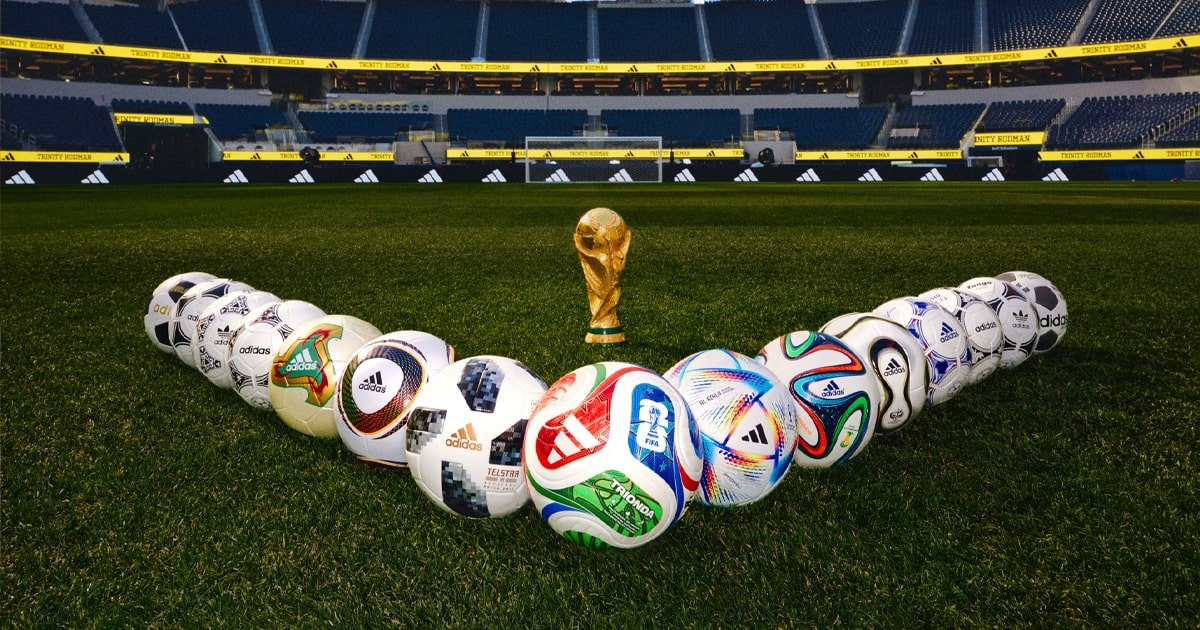
While the FIFA World Cup itself carries enormous weight, one of its most overlooked influences sits at the centre of every match: the official match ball. Every pass, shot, save, and tactical adjustment depends on how that ball behaves. Over time, changes in its design have quietly reshaped the rhythm and style of the game.
What looks like a simple piece of equipment has become a highly engineered performance tool. Today’s World Cup ball no longer just travels across the pitch; it carries data, symbolism, and precision engineering that influence the highest level of football.
This article explores how the FIFA World Cup match ball has developed from heavy leather constructions to digitally enhanced sports equipment, and why each stage has mattered for the way football is played.
The Official World Cup Match Ball And Why It Matters
The official match ball of the FIFA World Cup defines uniform conditions for every team in the competition. FIFA selects a single design for all matches so that players compete under identical equipment standards from the opening game to the final.
That consistency plays a major role in fairness. Without it, differences in ball weight, surface texture, or water resistance could influence match outcomes. A unified ball removes that uncertainty and ensures performance depends on skill rather than equipment variation.
It also supports preparation. National teams train extensively with the exact tournament ball, adjusting passing speed, shooting technique, and set-piece routines to match its behaviour. Even subtle differences in surface grip or flight response can alter tactical planning.
Beyond performance, the match ball also serves a visual and cultural function. Each edition reflects the identity of host nations and becomes part of the tournament’s global branding. For 2026, Adidas developed Adidas Trionda, designed to represent the United States, Canada, and Mexico through colour and symbolic detailing.
Early World Cup Footballs 1930 To 1966: Inconsistency And Experimentation
The early decades of the World Cup were defined by variation rather than standardisation. There was no single official match ball, and organisers often relied on local suppliers or host nation preferences. Historical records of the tournament show patterns in competition development, as seen in the complete FIFA World Cup winners list.
1930 Uruguay: Two Balls, Two Experiences
The first World Cup in Uruguay is a clear example of early inconsistency. Different balls were used depending on team preference, including separate designs from Argentina and Uruguay. In the final itself, both balls were used, with each half played using a different model.
That arrangement created noticeable changes in match rhythm. Players had to adjust to different bounces, weights, and flight behaviour within the same game. The lack of standardisation meant no consistent playing conditions across the tournament.
1934 To 1950: The Heavy Leather Era
During this period, footballs were made from hand-stitched leather panels with internal rubber bladders. While craftsmanship improved gradually, the fundamental material created major performance issues.
Leather absorbed water easily. In wet conditions, the ball became heavier mid-match, sometimes dramatically so. Shape distortion was also common, which affected passing accuracy and shot stability. The ball rarely behaved the same way twice under different weather conditions.
By 1950, improvements such as valve systems reduced air leakage, but the core problem remained unchanged: the material itself was not suited to consistent performance.
1954 To 1966: Gradual Improvement Without Unity
The following World Cup cycles introduced refinements in stitching, panel shaping, and construction quality. Balls became more spherical and slightly more predictable, but FIFA still did not enforce a single global design.
Manufacturers continued to vary by region and tournament. Some balls performed better than others, but no long-term development system connected one World Cup to the next. The sport remained dependent on local manufacturing standards rather than unified innovation.
By 1966, when England used a ball produced by Slazenger, FIFA began moving towards tighter control, setting the stage for a major shift in the next decade.
Modern Era Begins (1970–1986): Adidas Becomes Official Supplier
A turning point arrived in 1970 when Adidas became the official supplier of World Cup match balls. From that moment, a single manufacturer began shaping how the ball evolved across generations.
Telstar 1970: First Iconic World Cup Ball
The introduction of the Adidas Telstar changed football visually and technically. Its black and white 32-panel design was developed to improve visibility on television, especially during black and white broadcasts.
This was not just a cosmetic decision. It solved a real broadcasting limitation. For the first time, global audiences could clearly track the ball during live matches, which helped expand football’s international appeal.
The Telstar also established the 32-panel structure that influenced ball design for decades. It became one of the most recognisable sports objects ever created.
Telstar Durlast 1974: Improving Weather Performance
In 1974, Adidas introduced a polyurethane coating to reduce water absorption. This change helped stabilise weight and shape during wet conditions.
Players experienced more consistent performance in the rain, which reduced one of the biggest variables in earlier football. The match ball began to behave more reliably across different climates.
Tango 1978: A Lasting Visual Language
The launch of Adidas Tango introduced a design that would define football aesthetics for years. Its circular triad pattern created a sense of motion even when the ball was still.
The design became instantly iconic. It combined visual identity with improved manufacturing precision and influenced multiple future World Cup balls. The Tango concept remained central to football design language for more than two decades.
The match ball shares symbolic importance with the FIFA World Cup trophy and its symbolism, both representing global football identity.
1982 To 1986: Transition Toward Modern Materials
During the early 1980s, Adidas refined waterproofing techniques and improved durability. By 1986, synthetic materials began replacing full leather construction with the introduction of the Azteca.
This shift marked the beginning of modern football engineering. Synthetic surfaces reduced water absorption, stabilised shape retention, and improved consistency across matches. Football was entering a new technological phase.
Evolution Era (1990–2002): Technology and Branding Growth
This era transformed football design into a combination of performance engineering and cultural expression. Manufacturers moved fully away from leather and introduced layered internal structures that changed how the ball reacted to impact.
Etrusco Unico (1990) – First Fully Synthetic Inner Layer
The 1990 World Cup ball introduced polyurethane foam layers inside the structure. This improved consistency and reduced moisture impact, making performance more stable across conditions.
Questra 1994: Softer Control And Faster Response
The Adidas Questra introduced a softer outer layer that improved touch and control. It also reflected a space exploration theme, showing how design began to merge storytelling with performance.
Tricolore (1998) – First Multi-Colour World Cup Ball
The Adidas Tricolore was the first World Cup ball to use full colour integration. It reflected French national identity and marked a shift towards more expressive visual design.
Performance also improved through refined foam structures, increasing speed and responsiveness.
Fevernova (2002) – Foam Layer Innovation
The 2002 design introduced a more advanced foam core and bold visual identity. While it increased speed and responsiveness, some players felt it behaved differently at long range.
This period highlighted a growing tension in ball design: improving performance while maintaining predictable behaviour.
Modern High-Tech Era (2006–2022): Precision Engineering
Modern football entered a scientific phase where aerodynamics, surface structure, and digital systems became central to design.
Teamgeist 2006: Bonded Construction
The Teamgeist reduced panel count and removed stitching entirely. Thermally bonded panels created a smoother surface, improving flight consistency.
Jabulani 2010: The Most Debated Ball In History
The Adidas Jabulani became famous for its unpredictable flight behaviour. Reduced to eight panels, it produced erratic movement at high speed.
Goalkeepers in particular criticised its stability, while attackers benefited from its speed in certain situations. It remains one of the most controversial designs in football history.
Brazuca 2014: Restoring Balance
The Adidas Brazuca introduced a six-panel structure and extensive player testing. It restored consistency and became widely praised for its predictable flight behaviour.
Telstar 18 (2018) – Digital Chip Integration
This edition introduced an embedded NFC chip. While it did not affect performance, it marked the beginning of digitally connected match equipment.
Al Rihla (2022) – Fastest And Most Accurate Ball Design
The Adidas Al Rihla integrated sensor-based tracking that supported VAR and officiating decisions. It provided real-time data on ball movement and speed.
Football had entered a data-driven phase where the match ball contributed directly to decision-making. The commercial expansion of the tournament is evident in FIFA World Cup prize money and financial growth across recent editions.
2026 World Cup Ball: Trionda And The Next Evolution
The 2026 tournament introduces Adidas Trionda, designed for the first tri-nation World Cup hosted by the United States, Canada, and Mexico.
Design Inspired By Three Nations
The ball incorporates red, green, and blue wave patterns that represent each host country. Symbolic elements such as the maple leaf, eagle, and star are embedded into the surface design.
The name reflects unity across three regions and signals a shared hosting identity.
Advanced Aerodynamics
Engineers reduced panel complexity and refined seam geometry to stabilise airflow. The design improves consistency in flight while maintaining responsiveness during high-speed play.
Integrated Sensor System
A high-frequency motion sensor tracks ball movement and sends data to officiating systems. This supports VAR decisions and improves match accuracy.
Sustainability Focus
Manufacturers use synthetic materials and reduced waste production methods. The design prioritises durability while lowering environmental impact across manufacturing processes.
How FIFA World Cup Balls Affect Gameplay
Changes in ball design directly affect how football is played at the elite level. Even small adjustments in surface texture or panel structure alter match dynamics.
Faster ball speed increases the pace of attacking play. Reduced air resistance leads to late movement in shots, making long-range attempts more dangerous. Goalkeepers must react faster and often deal with unpredictable dips or curves.
Strikers benefit from increased shot power but lose some control and precision. Small differences in striking technique can produce larger changes in direction.
Teams adjust tactical systems accordingly, favouring quicker passing, more long-range attempts, and deeper goalkeeper positioning.
Why Adidas Dominates FIFA World Cup Ball Design
Adidas maintains its position through long-term partnerships, engineering expertise, and global brand reach.
Since 1970, it has supplied every official World Cup ball, creating a continuous development cycle based on elite match data. Each tournament builds on the last, improving aerodynamics, control, and consistency.
Adidas also leads in global visibility. Every World Cup match showcases its equipment, reinforcing its presence in both sport and commercial markets.