This Article Was Last Updated: August 29, 2026 by Victor Odia
Many fans confuse the FIFA World Cup and the FIFA Club World Cup because FIFA organises both competitions and many of the world’s best players appear in each. They are different tournaments with different goals.
This guide explains who plays in each competition, how teams qualify, how the tournaments work, and why each trophy matters. A comparison table at the end highlights the key differences.
What Are the FIFA World Cup and FIFA Club World Cup?
The FIFA World Cup is for national teams, while the FIFA Club World Cup is for professional football clubs.
FIFA World Cup
What It Is
The FIFA World Cup is the biggest men’s international football tournament. National teams qualify through continental competitions, and FIFA holds the tournament every four years to crown the world’s best national side.
Since 2026, the tournament has featured 48 teams.
Purpose
The FIFA World Cup:
- Crowns the world’s best national team.
- Promotes football worldwide.
- Brings countries together through sport.
- Gives more nations the chance to compete.
History
The first FIFA World Cup took place in Uruguay in 1930 with 13 teams. Uruguay won the inaugural title.
Key milestones:
- 1930: First FIFA World Cup.
- 1950: Tournament returned after World War II.
- 1998: Expanded to 32 teams.
- 2026: Expanded to 48 teams and 104 matches.
Frequency
The tournament takes place every four years. The 1942 and 1946 editions were cancelled because of World War II.
Number of Teams
| Period | Teams |
| 1930 | 13 |
| 1934–1978 | 16 |
| 1982–1994 | 24 |
| 1998–2022 | 32 |
| 2026 onwards | 48 |
The 2026 format includes:
- 48 teams
- 12 groups of four
- Top two teams from each group plus the eight best third-placed teams reaching the Round of 32
- 104 matches
FIFA Club World Cup
What It Is
The FIFA Club World Cup brings together the world’s leading professional clubs. Players represent their clubs rather than their countries.
Purpose
The tournament:
- Crowns the world’s best club.
- Brings together champions from every continent.
- Expands international club football.
- Promotes the global game.
History
FIFA launched the competition in 2000 before relaunching it in 2005 as the replacement for the Intercontinental Cup.
From 2005 to 2023, the tournament featured the continental champions from UEFA, CONMEBOL, AFC, CAF, Concacaf and OFC, plus the host nation’s league champion.
32-Team Format
FIFA introduced a new format in 2025 featuring:
- 32 clubs
- Eight groups of four
- Top two clubs reaching the Round of 16
- Knockout rounds to the final
- No third-place play-off
- Qualification based on continental success and four-year club rankings
Frequency
The FIFA Club World Cup is held every four years. The annual seven-team format ended after 2023.
Number of Teams
| Period | Teams |
| 2000 | 8 |
| 2005–2023 | 7 |
| 2025 onwards | 32 |
The 32 places are allocated as follows:
- UEFA: 12
- CONMEBOL: 6
- AFC: 4
- CAF: 4
- Concacaf: 4
- OFC: 1
- Host nation: 1
FIFA World Cup vs FIFA Club World Cup: Key Differences
| Feature | FIFA World Cup | FIFA Club World Cup |
| Teams | National teams | Professional clubs |
| Qualification | Continental qualifiers | Continental competitions, rankings and host club |
| Format | 48 teams, Round of 32 | 32 teams, Round of 16 |
| Trophy | FIFA World Cup Trophy | FIFA Club World Cup Trophy |
| Prestige | Highest honour in international football | Highest honour in club football |
Teams
The FIFA World Cup features national teams representing FIFA member associations. Players compete for their countries under FIFA eligibility rules.
The FIFA Club World Cup features professional clubs. Players represent the clubs where they are registered, regardless of nationality.
Examples of World Cup teams:
- Brazil
- Argentina
- England
- France
- Nigeria
Examples of Club World Cup teams:
- Real Madrid
- Chelsea
- Manchester City
- Palmeiras
- Al Ahly
Qualification
The two tournaments use different qualification systems.
FIFA World Cup
National teams qualify through FIFA’s six confederations:
- UEFA
- CONMEBOL
- CAF
- AFC
- Concacaf
- OFC
The United States, Canada and Mexico qualified automatically as 2026 hosts. All other nations qualified through continental competitions.
FIFA Club World Cup
Most clubs qualify by winning their continent’s leading competition, including:
- UEFA Champions League
- Copa Libertadores
- CAF Champions League
- AFC Champions League Elite
- Concacaf Champions Cup
- OFC Champions League
Some places are awarded through FIFA’s club ranking system, with one reserved for the host nation’s club.
Tournament Format
Both competitions begin with a group stage before moving into knockout rounds.
FIFA World Cup
- 48 teams
- 12 groups
- Round of 32
- 104 matches
- Best third-placed teams also qualify
FIFA Club World Cup
- 32 teams
- Eight groups
- Round of 16
- 63 matches
- Only the top two teams in each group qualify
The World Cup lasts around six weeks, while the Club World Cup is played after most domestic league seasons finish.
Trophy
Each tournament awards its own trophy.
FIFA World Cup Trophy
Introduced in 1974, the trophy is made from 18-carat gold and shows two figures holding the Earth. It symbolises international football’s greatest achievement.
FIFA Club World Cup Trophy
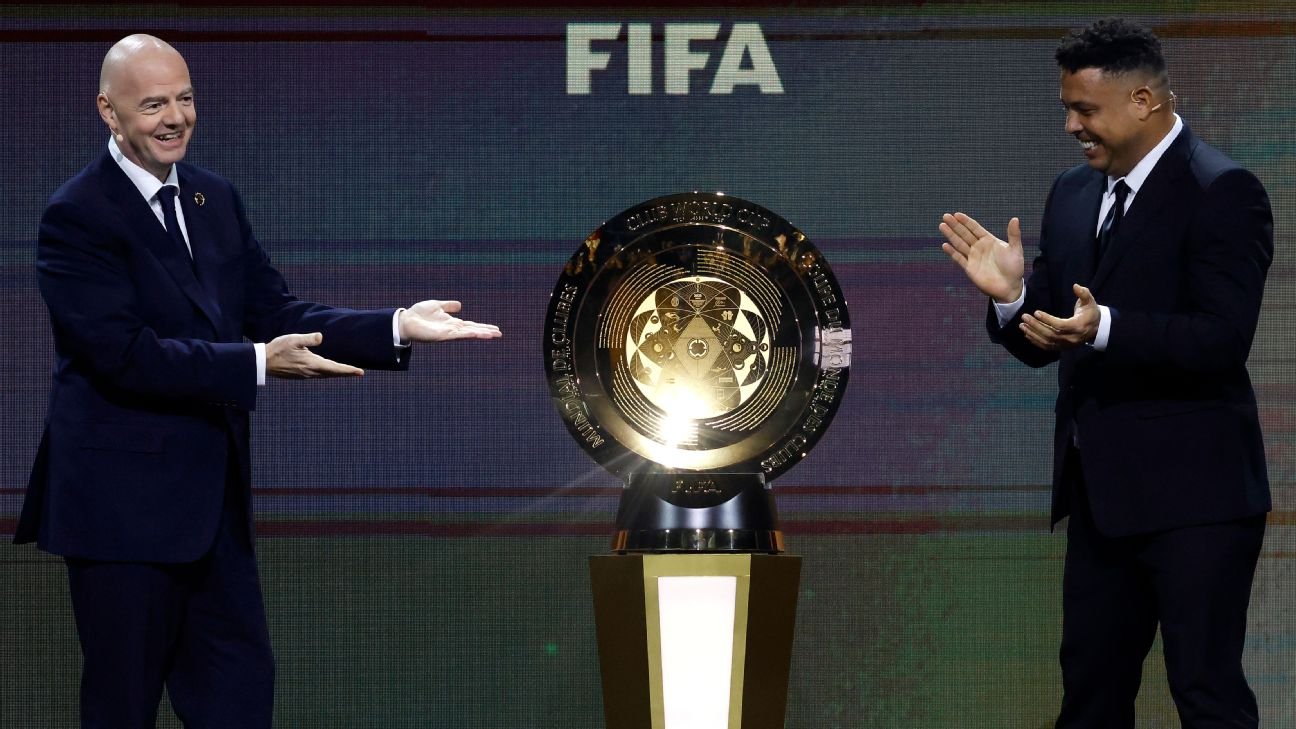
Introduced in 2025, the redesigned trophy features a circular shape with rotating sections and engraved details celebrating global club football.
FIFA keeps both original trophies. Champions lift the originals during the presentation before receiving an official replica or winners’ trophy.
Prestige
The FIFA World Cup remains the biggest competition in international football. It attracts billions of viewers and is the sport’s most prestigious prize.
The FIFA Club World Cup crowns the world’s best club. The expanded 32-team format has increased its profile, prize money and global audience, although it remains smaller than the World Cup.
Similarities Between the FIFA World Cup and FIFA Club World Cup
Both tournaments:
- Are organised by FIFA.
- Take place every four years.
- Feature elite players.
- Include teams from all six confederations.
- Use a group stage followed by knockout rounds.
- Use VAR and FIFA match officials.
- Award official FIFA trophies and medals.
- Attract worldwide television audiences.